
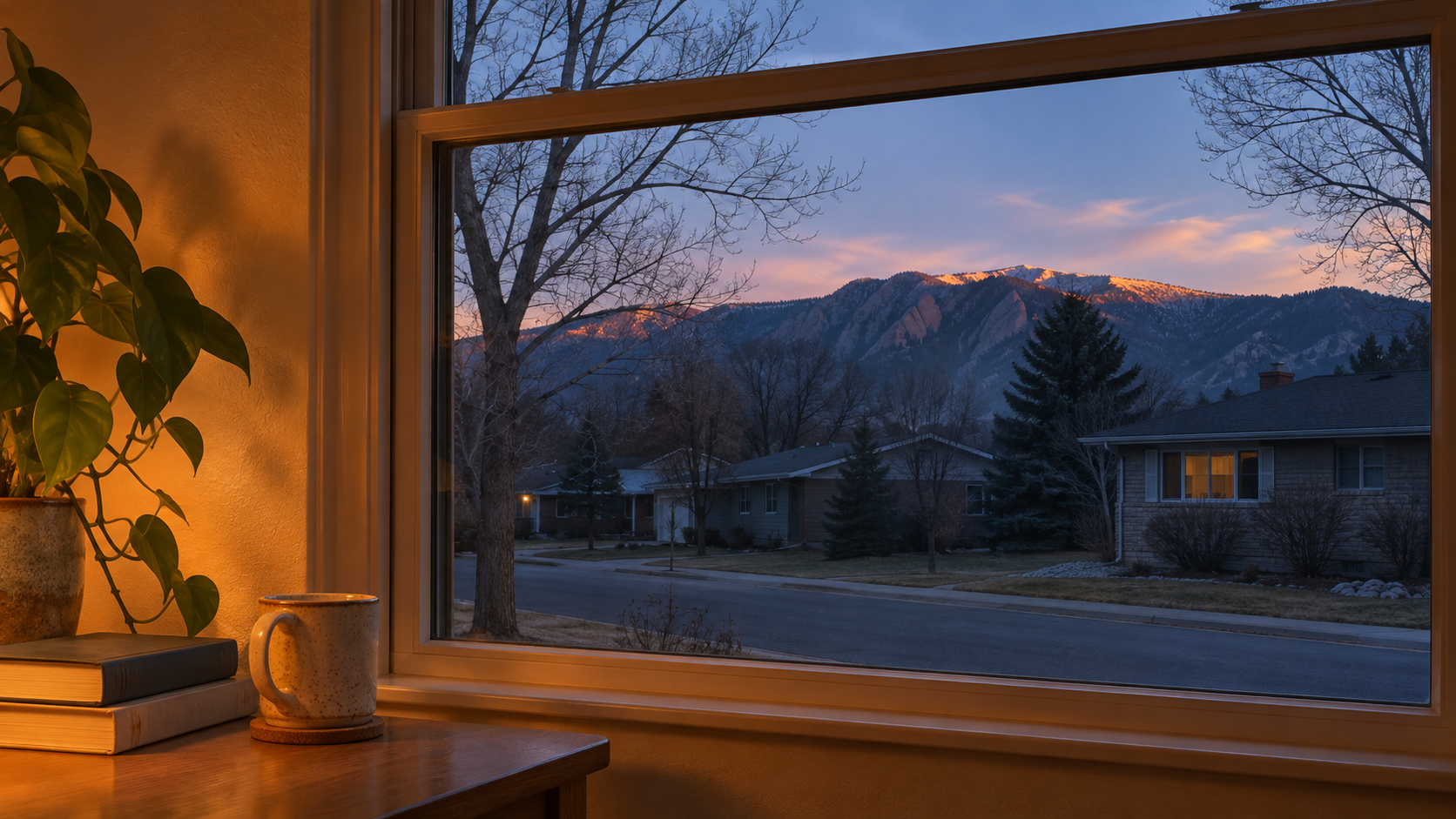
The clocks went back this weekend, so tonight is the first one where you leave work and it is already over outside.
And then there is the thing people say about living here, which is that we get all this sun, so this should not be a problem. You may have said it to yourself. It can be sixty degrees and cloudless in November and you still cannot get yourself to do anything after six.
If something in your mood shifts every year around now, and every year you decide it is just a mood and wait it out, it is worth knowing that there is a mechanism underneath it and it is not mysterious.
So, what actually changes in November? How does it show up? Why does it catch people in a state this bright? And what can you actually do about it?
So, what actually changes in November?
The variable is not how sunny it is. It is how long the day is, and when the light arrives.
Denver sits near the fortieth parallel. In late June the sun is up for close to fifteen hours. By the December solstice it is up for about nine and a half. That is more than five and a half hours of daylight gone, and almost all of it comes off the end of the day, which is the part you had plans in.
The National Institute of Mental Health puts the geography on blast here. Winter-pattern seasonal affective disorder is more common in people living farther north, because winter daylight hours are shorter there, which is why it turns up more in New England than in Texas. Colorado is sunny, and Colorado is also nowhere near the equator. Those two facts do not cancel each other out. Sunshine totals are not the thing being measured.
How does it show up when it does not look like sadness?
This is where people miss it, including people who have had it for years. They are watching for sadness, and sadness is often the first thing we experience.
What shows up more often is a flattening. The alarm goes off and getting up takes something it did not take in September. You sleep longer and wake up still feeling unrested. Dinner starts wanting bread and pasta and not much else. The evening plan gets cancelled, usually by text, usually with a real reason attached.
Those are on the clinical list. NIMH names oversleeping, overeating with a craving for carbohydrates, and social withdrawal, which it describes as feeling like hibernating, among winter-pattern symptoms.
Worth being careful with that list, though. Seasonal affective disorder is a diagnosis, which means it is something you arrive at with a clinician who knows your history, not something to engage your Google PhD with. What the list is good for is recognizing that what you are in has a shape.
And if it comes back in the same six weeks every year, that recurrence is information. It is telling you your mood tracks something in your environment, which is considerably more useful to know than most of the explanations people reach for instead.
I have had clients who had been through this six or seven times before anyone connected it to the season. If I ask them to give it a color, it’s usually seen as a black, or other darker color. They also describe the feeling as cold, which makes sense.
Why does it catch people in a state this bright?
Here is the part that catches people who live somewhere sunny.
The light has to reach you, and most of ours now arrives while you are indoors. The sun sets before five from early November, and by the start of December it is down around four thirty-five. The bright stretch of a winter day here happens while most working adults are inside, with the commute at both ends done in the dark or close to it.
A room that feels perfectly bright is dim by outdoor standards. That is the reason the light boxes used clinically are built to ten thousand lux, per NIMH, rather than to the level of a good lamp.
So the sun is out... you are just not in it. For a lot of people here the only real daylight exposure of the week lands on Saturday, and five days of garage to garage is enough to do this on its own.
So what can you actually do about it?
Before the practical part, something to sit with.
You have probably told yourself that the weather here is no excuse, because you live in one of the sunnier places in the country (and it’s, like, RIGHT there). You have probably also not been outside in real daylight since Tuesday morning. Both of those are true at once, and neither of them is unreasonable. It is worth asking which one you have been arguing with.
What the mechanism suggests is less about doing more and more about when.
Move your light to the front of the day. A walk in the first hour or two after you get up, actually outside rather than next to a window, does more than the same walk at lunch. You are trying to give the day a clear start.
Hold the wake time still. NIMH notes that people with winter-pattern SAD produce too much melatonin, which pushes toward oversleeping, and sleeping in on weekends drags the whole system later. A steady wake time is dull and it is usually the lever that moves the others.
If you use a light box, use it like a treatment. NIMH describes the standard protocol as a ten thousand lux box for about thirty to forty-five minutes a day, in the morning. It is worth a conversation with a provider before starting, because timing and dose matter and they are not the same for everyone.
Keep one thing on the calendar that happens after dark. The withdrawal part of this is self-reinforcing. One standing commitment, with other people, that you did not have to decide about on the night is worth more than three good intentions.
Then there is the treatment with the most interesting evidence behind it, which is not the light box.
Cognitive behavioral therapy adapted for seasonal depression, CBT-SAD, performed about as well as light therapy in the winter it was delivered. NIMH says as much. The difference showed up later. In a trial of 177 adults followed across two winters, published in the American Journal of Psychiatry, depression recurrence in the second winter was 27.3 percent after CBT-SAD compared with 45.6 percent after light therapy.
The reading of that is not complicated. A light box works while you are using it, and most people stop using it. The thinking and the scheduling you work out in one winter are still yours in the next one. If you want the longer version of how that work actually goes, there is a fuller explainer on the blog about what CBT looks like in practice.
You probably already know which of the four items above you have been working around. So, start with that one!
When is it worth talking to someone?
There is no threshold you have to cross before this counts. But there is a difference between a dip that moves through and one that settles in, and that difference is usually what people describe later as the point they wish they had called.
If this arrives every year and takes the winter with it, if the sleep is long and never restful, if you have stopped doing the things you moved here to do, that is enough to bring to somebody.
And if part of what is holding you back is a sense that you should have a handle on this by now, after however many Novembers you have seen, consider that a true master is an eternal student. Nobody reaches the point where they are finished learning how their own wiring answers to a season.
Most people arrive already knowing what they want, which is a winter that costs them less. The part worth having company for is the how, and that is what depression therapy is actually for.
Ultimately, if this sounds like where you are, reach out. To me, or to whichever therapist you click with. It is early November, which is a considerably better time to start this than February.
Ready to talk it through? Book a free 15-minute consultation. https://heartnmindhealing.com/appointments?utm_source=blog&utm_medium=organic&utm_campaign=seasonal-depression-in-colorado
Written by Carl Fritzen, M.A., LPC Licensed Professional Counselor | Heart and Mind Healing | Denver, Colorado
Carl Fritzen is a Licensed Professional Counselor and the founder of Heart and Mind Healing, a private therapy practice serving adults in the Denver metro area. He works with anxiety, life transitions, boundaries, and burnout, blending cognitive behavioral and acceptance-based tools with trauma-informed and psychodynamic work. His focus is practical change that holds up outside the therapy room.
Sessions are 50 minutes, in person in Cherry Creek or by telehealth across Colorado. New clients can start with a free 15-minute consultation.
Disclaimer
This post is for general education and is not a substitute for individual therapy, diagnosis, or treatment. If you are in crisis, call or text 988 to reach the Suicide and Crisis Lifeline.